
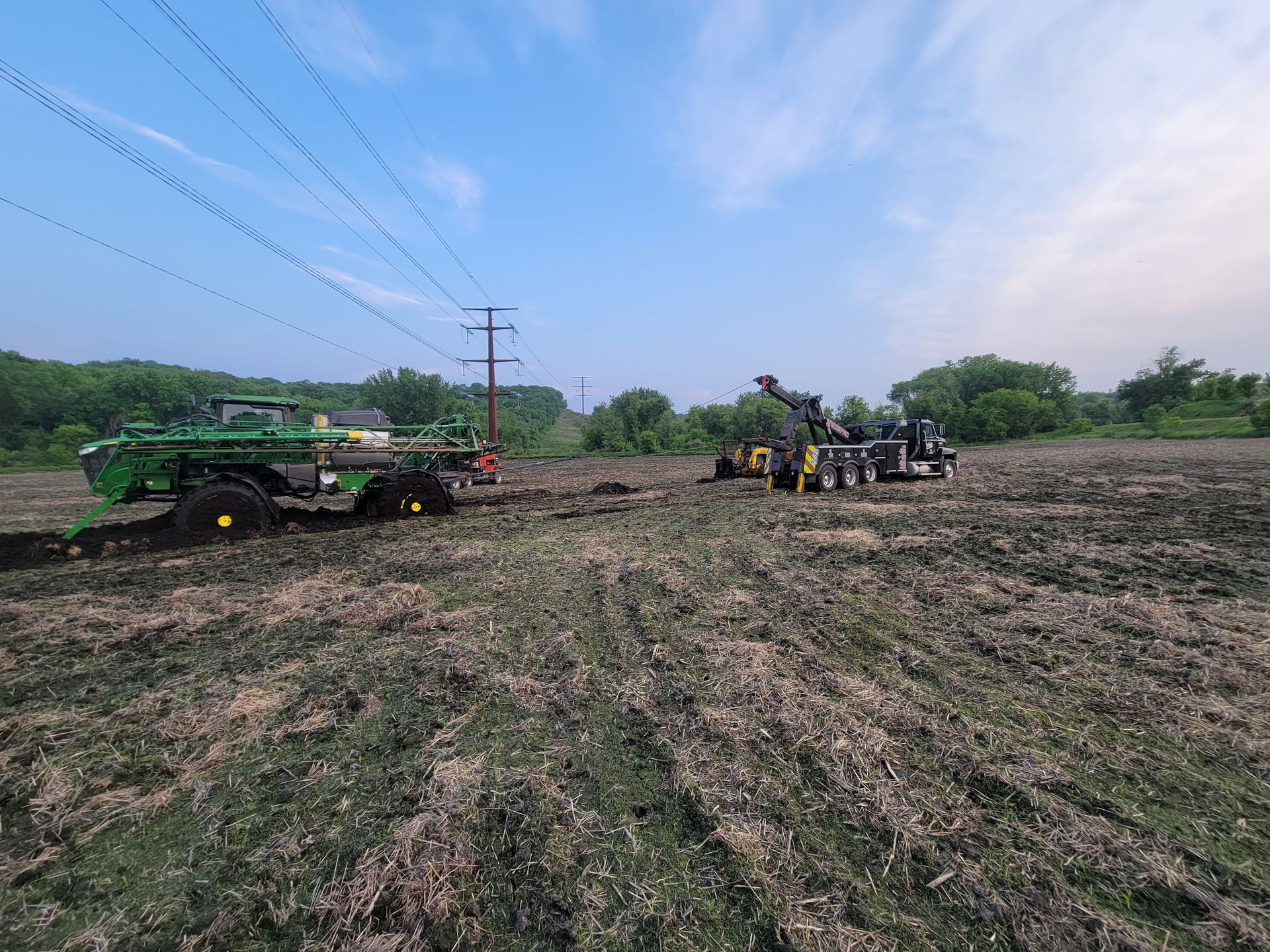
Vehicles Extracted From Remote Locations Intact
Off-Road Recovery in Taylor for semi-trucks and heavy equipment stranded in fields, wooded areas, and construction sites
A logging truck that slides off a forest trail or a semi that leaves pavement to avoid a collision and sinks into a plowed field requires off-road recovery equipment that can reach locations inaccessible to standard tow trucks. Off-road recovery from Klinger's Shop handles commercial vehicles, trailers, and heavy equipment stranded on gravel roads, construction sites, agricultural land, and remote rural areas across Taylor and western Wisconsin where terrain, vegetation, or distance from paved roads prevents conventional towing. The goal is extracting disabled or stuck vehicles without causing frame damage, drivetrain failures, or additional body harm that occurs when equipment is dragged across uneven ground or pulled at angles that twist structural components.
Recovery procedures depend on terrain type and vehicle position—trucks in open fields allow direct approaches with recovery equipment, while wooded areas or soft ground require rigging from a distance using extended winch lines and intermediate anchor points. Operators evaluate soil stability, slope angles, and vegetation obstacles before choosing extraction methods, because pulling a truck through standing crops or across rutted ground without mats or stabilization creates deeper entrenchment instead of progress. Agricultural operations, construction crews, and trucking companies around Taylor face off-road recovery situations when delivery routes cross unpaved property or weather turns access roads impassable.
Contact Klinger's Shop for off-road recovery by providing the vehicle's location using landmarks or GPS coordinates, describing the terrain conditions, and stating whether the vehicle is stuck or mechanically disabled.
What Safe Off-Road Extraction Involves
Off-road recovery starts with accessing the stranded vehicle using equipment rated for rough terrain, then assessing ground conditions to determine if recovery equipment will sink or remain stable during pulling operations. Heavy-duty recovery rigs designed for off-pavement work carry ground mats that distribute weight across soft soil, along with extended winch lines that allow pulling from solid anchor points when the recovery vehicle can't get close without becoming stuck itself. Multiple rigging points spread pulling force and prevent frame twisting when extraction paths aren't straight or terrain creates uneven resistance.
After recovery, your vehicle sits on solid ground or accessible roadway without frame damage, broken suspension components, or drivetrain harm caused by improper extraction techniques. Any mechanical issues that led to the off-road incident or occurred during it can then be assessed and repaired, whether the truck left the road due to brake failure, steering problems, or external factors like weather or collision avoidance.
Challenging recovery conditions—steep slopes, dense vegetation, or vehicles that have rolled or tipped—extend recovery time because rigging must be repositioned, ground must be stabilized, or additional equipment must be brought to the site. Some situations require clearing access paths or waiting for ground conditions to firm up before extraction becomes safe for both the vehicle and the recovery operators.
What Drivers and Fleet Managers Ask
Off-road recovery situations raise specific questions about access, procedures, and the condition of vehicles after extraction.
What makes off-road recovery different from standard roadside towing?
Off-road recovery involves extracting vehicles from locations where terrain prevents direct towing access—fields, wooded areas, ditches far from pavement, or construction sites. It requires winching, ground stabilization, and equipment capable of operating on unpaved, uneven, or soft surfaces where standard tow trucks can't function safely.
How do recovery operators avoid getting their own equipment stuck while extracting vehicles?
Recovery rigs designed for off-road work have ground clearance, weight distribution, and tire configurations suited to rough terrain, and operators use ground mats to prevent sinking. When terrain is too unstable, winching happens from a distance using extended cables anchored to trees, equipment, or portable anchors rather than driving recovery equipment into the same conditions that trapped the original vehicle.
Why do some off-road recoveries in Taylor require waiting for better conditions?
Saturated soil during spring thaws or after heavy rains makes ground too soft to support recovery equipment, and attempting extraction under those conditions risks getting additional vehicles stuck. Frozen ground during winter actually makes some recoveries easier because the surface is solid, but extreme cold can make equipment brittle and hazardous to operate.
What happens if a vehicle rolled or tipped during an off-road incident?
Overturned vehicles require uprighting before they can be extracted, which involves additional rigging to control the roll direction and prevent further damage. Once upright, the vehicle is assessed for structural and mechanical damage, and extraction proceeds using methods appropriate for its condition—some severely damaged trucks may need partial disassembly or specialized transport after recovery.
How does cargo affect off-road recovery procedures?
Loaded vehicles are significantly heavier and require stronger rigging and pulling capacity, but unloading cargo in a remote field isn't always feasible. Recovery teams assess whether extraction is possible with the load intact or if partial unloading is necessary to reduce weight and prevent equipment failure during pulling operations.
Klinger's Shop provides off-road recovery for semi-trucks, heavy equipment, and commercial vehicles stranded across western Wisconsin's agricultural land, industrial properties, and remote rural locations. Call immediately if your vehicle is off-road and unable to return to pavement without assistance.